
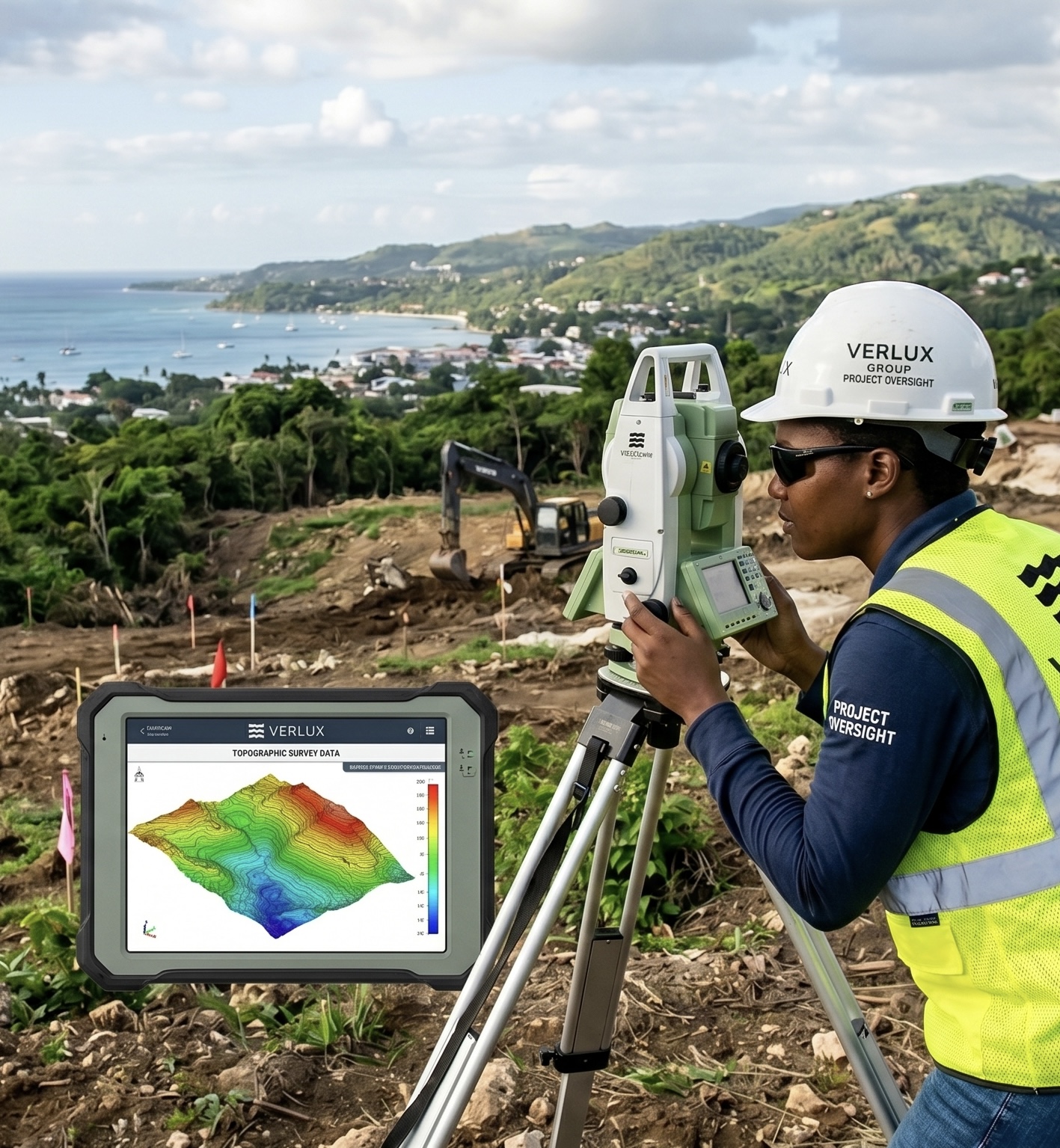
What Is A Topography Report And Why Your Build Can't Start Without One
When most people think about building in Jamaica, they think about the design, the materials, and the contractor. Very few think about the ground beneath their feet. That is a costly oversight, and in some cases it is one that cannot be undone.
Before a single foundation is poured, before a single wall goes up, the land your home will sit on needs to be properly understood. A topography report is how that understanding is established, and skipping it is one of the most expensive mistakes a diaspora client can make.
What Is A Topography Report?
A topography report, sometimes referred to as a topographic survey, is a detailed assessment of the physical characteristics of a piece of land. It maps the surface of the land including its elevation, slopes, contours, drainage patterns, and any natural or man-made features that exist on or around it.
In simple terms, it tells you exactly what kind of land you are working with before you commit to building on it.
This is not the same as a land survey, which establishes the legal boundaries of a property. A topography report goes further by giving your architect, engineer, and contractor the technical information they need to design a structure that is safe, stable, and appropriate for that specific piece of ground.
Why Does It Matter So Much In Jamaica?
Jamaica is a mountainous island with highly varied terrain. The same parish can have flat coastal land, steep hillside plots, and everything in between. Land that looks perfectly buildable to the untrained eye can present serious challenges once the ground is properly assessed.
Some of the issues a topography report can reveal include:
- Slopes that require significant earthworks or retaining walls before building can begin
- Drainage problems that could lead to flooding or water damage during heavy rainfall
- Soil instability or erosion risk that affects the type of foundation required
- Proximity to gullies, ravines, or natural watercourses that restrict where a structure can be placed
- Rock formations that affect excavation costs and timelines
Any one of these issues can have a significant impact on your budget and your timeline. Discovering them after construction has started is far more expensive than identifying them before a shovel hits the ground.
The Real Cost Of Skipping It
It is tempting to skip a topography report, particularly when you are eager to get started and someone is telling you the land looks fine. The report costs money. It takes time. And when you are building from abroad and already managing a complicated process from a distance, one less thing to organise feels like a relief.
But consider what happens when the report is skipped and a problem is discovered mid-build. Foundations may need to be redesigned. Retaining walls may need to be added at significant cost. In serious cases, sections of a build may need to be demolished and started again. There have been instances where land that appeared suitable turned out to be fundamentally inappropriate for the structure being planned, leaving clients with a partially built home and no straightforward path forward.
The cost of a topography report is a fraction of what any one of those scenarios would set you back.
Who Carries Out A Topography Report?
A topography report is carried out by a licensed land surveyor with the appropriate qualifications and equipment. In Jamaica, land surveyors are regulated and must be registered with the relevant professional body.
Your architect or structural engineer will typically be able to recommend a qualified surveyor, or you can approach the relevant professional association directly. What is important is that the person carrying out the survey has the credentials and the experience to produce a report that your design team can actually work from.
Do not accept an informal assessment from someone who simply walks the land and gives you their opinion. That is not a topography report and it will not give you the information you need.
How It Feeds Into The Rest Of Your Build
A topography report does not sit in isolation. The information it produces feeds directly into several other critical parts of your project.
Your architect uses it to position the structure correctly on the land and design a layout that works with the natural contours rather than against them. Your structural engineer uses it to determine the appropriate foundation type and depth for the specific ground conditions. Your contractor uses it to plan earthworks, drainage, and site preparation before construction begins.
Without it, each of these professionals is working with incomplete information. And incomplete information at the design stage becomes expensive problems at the construction stage.
When Should You Get It Done?
The topography report should be one of the first things commissioned once you have secured your land and are moving towards the design phase. It needs to happen before your architect finalises drawings and before your structural engineer begins their calculations.
Getting it done early means any issues are identified and factored into the design from the start. Getting it done late, or not at all, means those issues surface when they are far harder and more expensive to address.
The Bottom Line
Jamaica's terrain is part of what makes it beautiful. It is also part of what makes building on it more complex than people expect. A topography report is not a bureaucratic formality. It is the document that tells you, your architect, your engineer, and your contractor exactly what you are working with.
If someone is advising you to skip it or telling you it is not necessary, that is a red flag worth taking seriously.
At VERLUX Group, we make sure our clients have the right professional reports in place before a single decision is made about design or construction. Because a build that starts on solid ground, literally and figuratively, is one that is far more likely to finish on budget and on time.
Want independent guidance on the reports and assessments your build actually needs? Contact VERLUX Group today.
"Verlux took the mystery out of investing in Jamaica. They showed me what I couldn't see on my own.”

Ready to invest wisely
Planning a development or
refurbishment in Jamaica from
overseas? Speak to us before you
commit capital